Ten rungs, from a grid to a digital twin
Ten simulations, each in a new field and each inheriting every tool below it. It starts with a forest fire on a NumPy grid and ends with a 3D campus model driven by real bus GPS, real buildings, a real solar year and 17,579 real crystal structures. No rung counts as done until it has matched a known answer, from theory or published data.
-
 Level 1 · Statistical physics · ecology
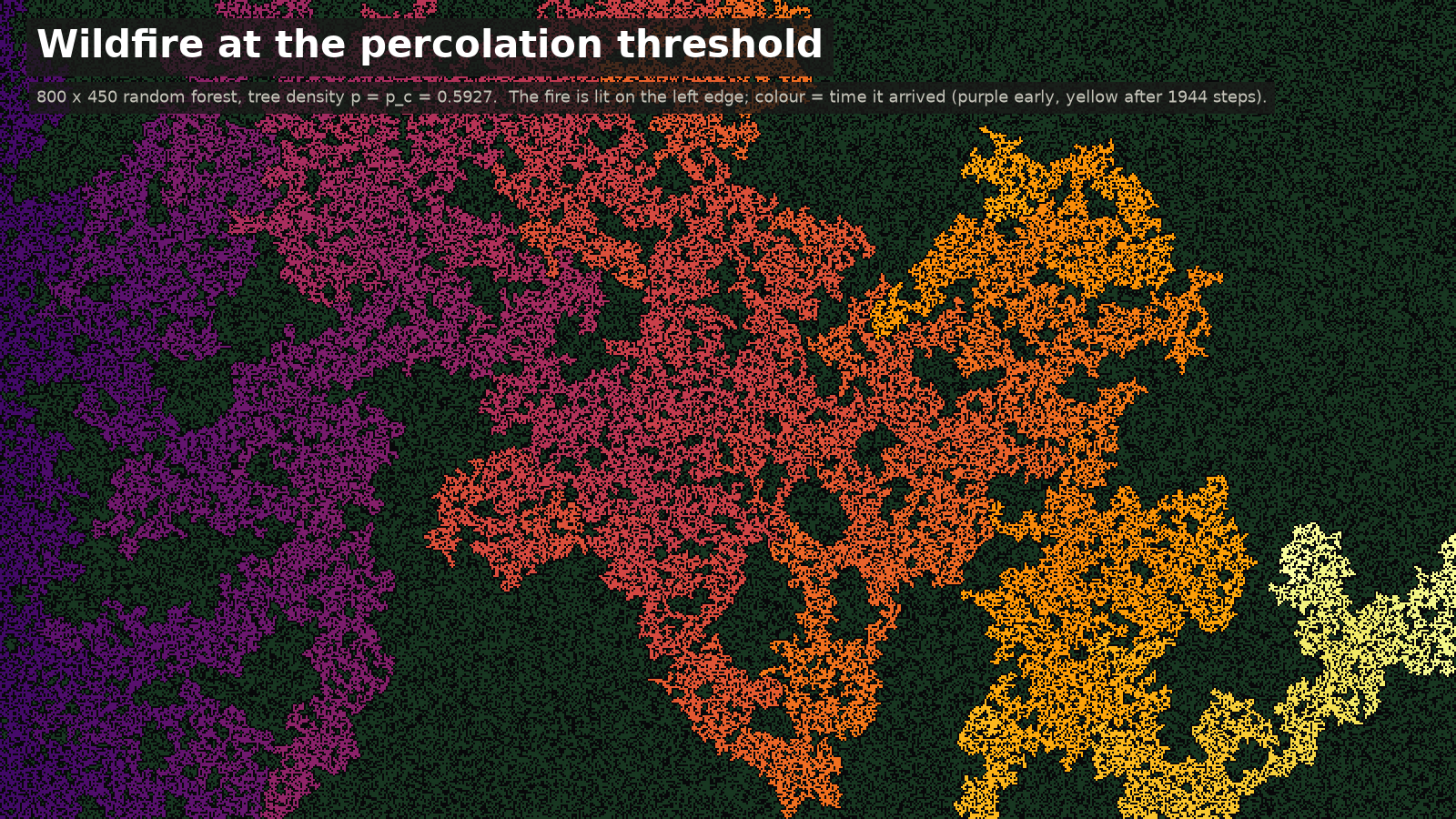
Wildfire Percolation
Cellular automata · Monte Carlo · phase transitionsWhy a forest at 59% tree density burns end to end and one at 55% does not. Plus self-organised criticality, where fires follow a power law nobody wrote into the rules.
+ NumPy+ MatplotlibVERIFIEDPercolation threshold 0.5936 ± 0.0007 vs 0.5927 in theory; forest-fire density 0.3978 vs 0.3976 (Grassberger 2002). -
 Level 2 · Systems & synthetic biology
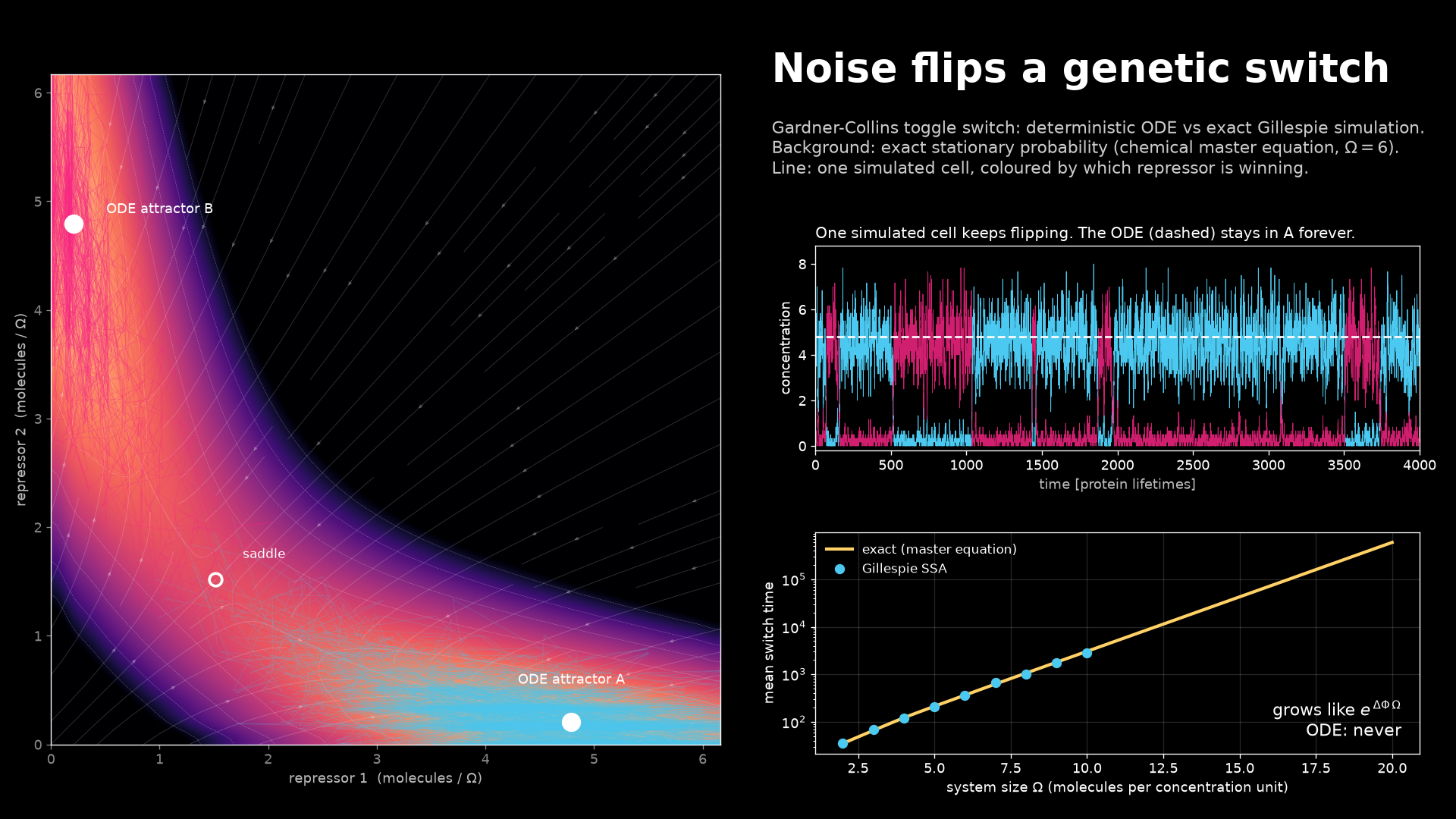
Noise in Gene Circuits
ODEs vs exact stochastic simulationA genetic toggle switch that the deterministic equations say can never flip, which flips anyway once you count molecules one at a time.
+ SciPy solve_ivp+ Gillespie SSAVERIFIEDGillespie runs match the exact master equation (total-variation distance 0.007); switching time grows like e^(0.53 Ω). -
 Level 3 · Operations research
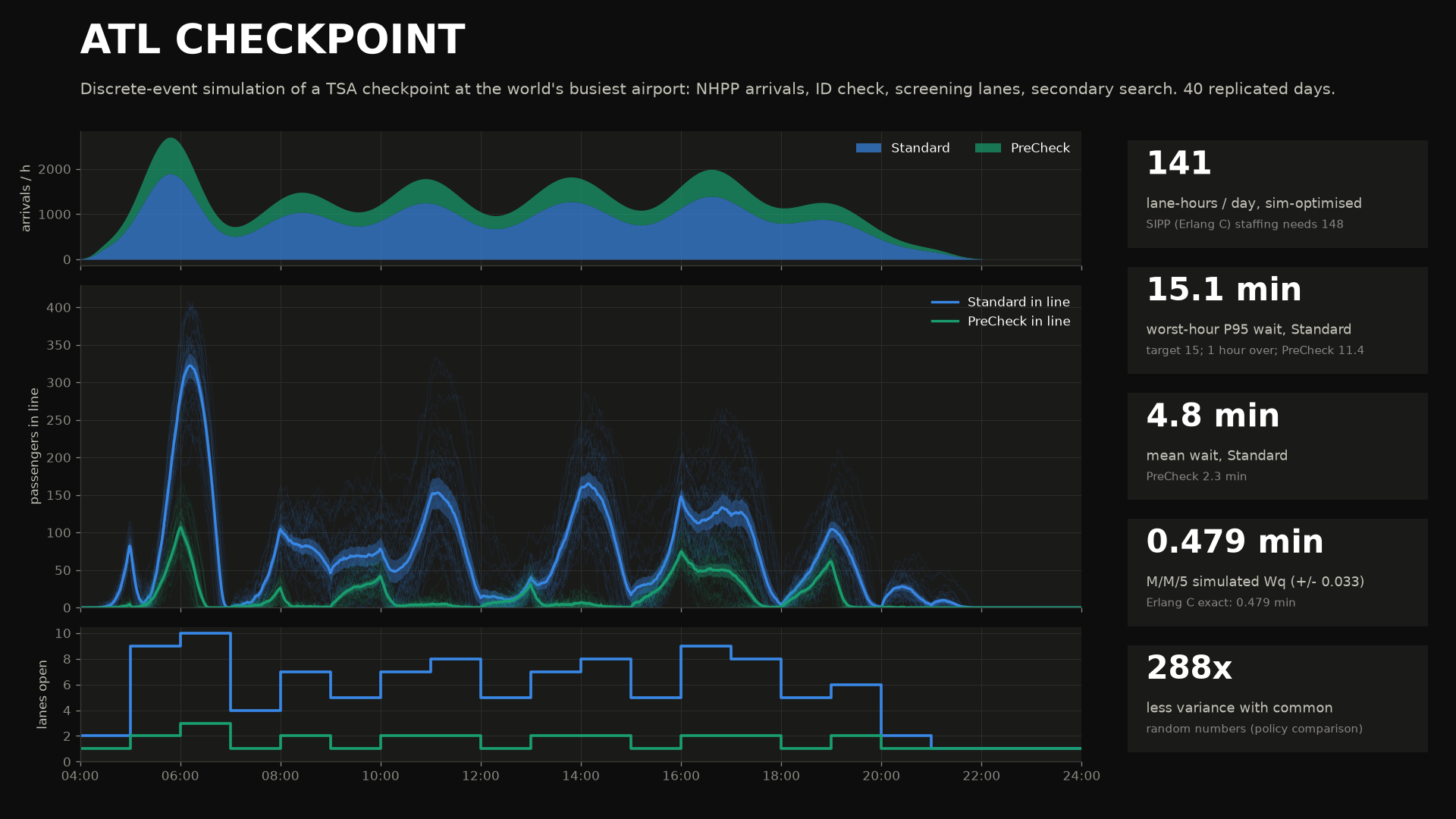
ATL Checkpoint
Discrete-event simulation · output analysis · optimisationA TSA checkpoint at the world's busiest airport: time-varying arrivals, PreCheck and secondary screening. What is the cheapest staffing that keeps the 95th-percentile wait under 15 minutes?
+ SimPy+ confidence intervals+ Erlang CVERIFIEDM/M/5 queue: Erlang C gives a 0.4789 min wait, the simulation 0.4793 ± 0.033. The robust plan needs 141 lane-hours vs 148 for textbook staffing. -
 Level 4 · Computational social science
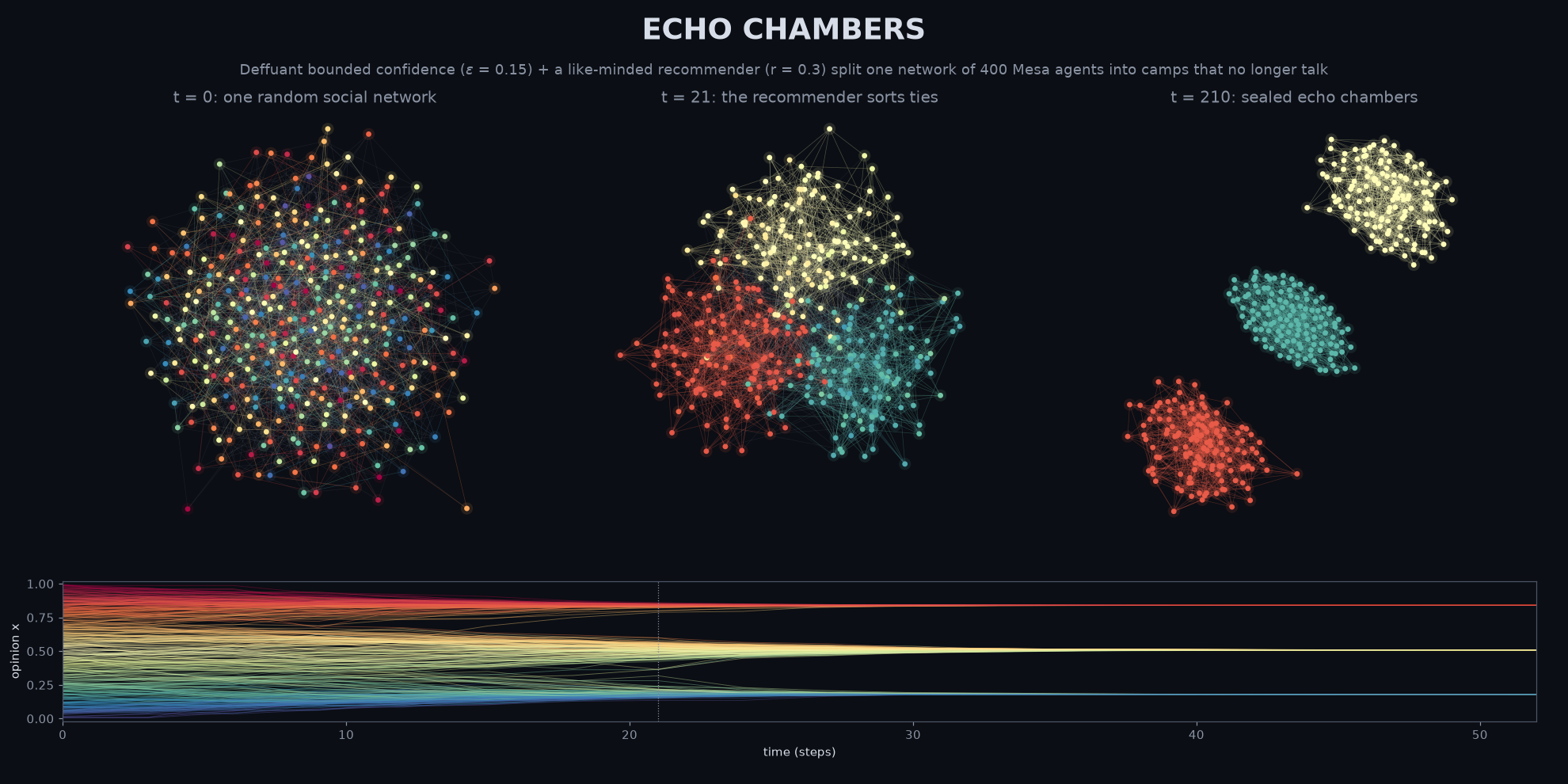
Echo Chambers
Agent-based modelling on adaptive networksBounded-confidence agents on a social network, plus a recommender that rewires ties toward agreement. When does a society reach consensus, polarise or shatter?
+ Mesa 3+ NetworkX+ parallel sweepsVERIFIEDOpinion-cluster counts follow ⌊1/2ε⌋ (Deffuant 2000) at all five ε tested. With the recommender, camps seal into disconnected networks in 100% of runs. -
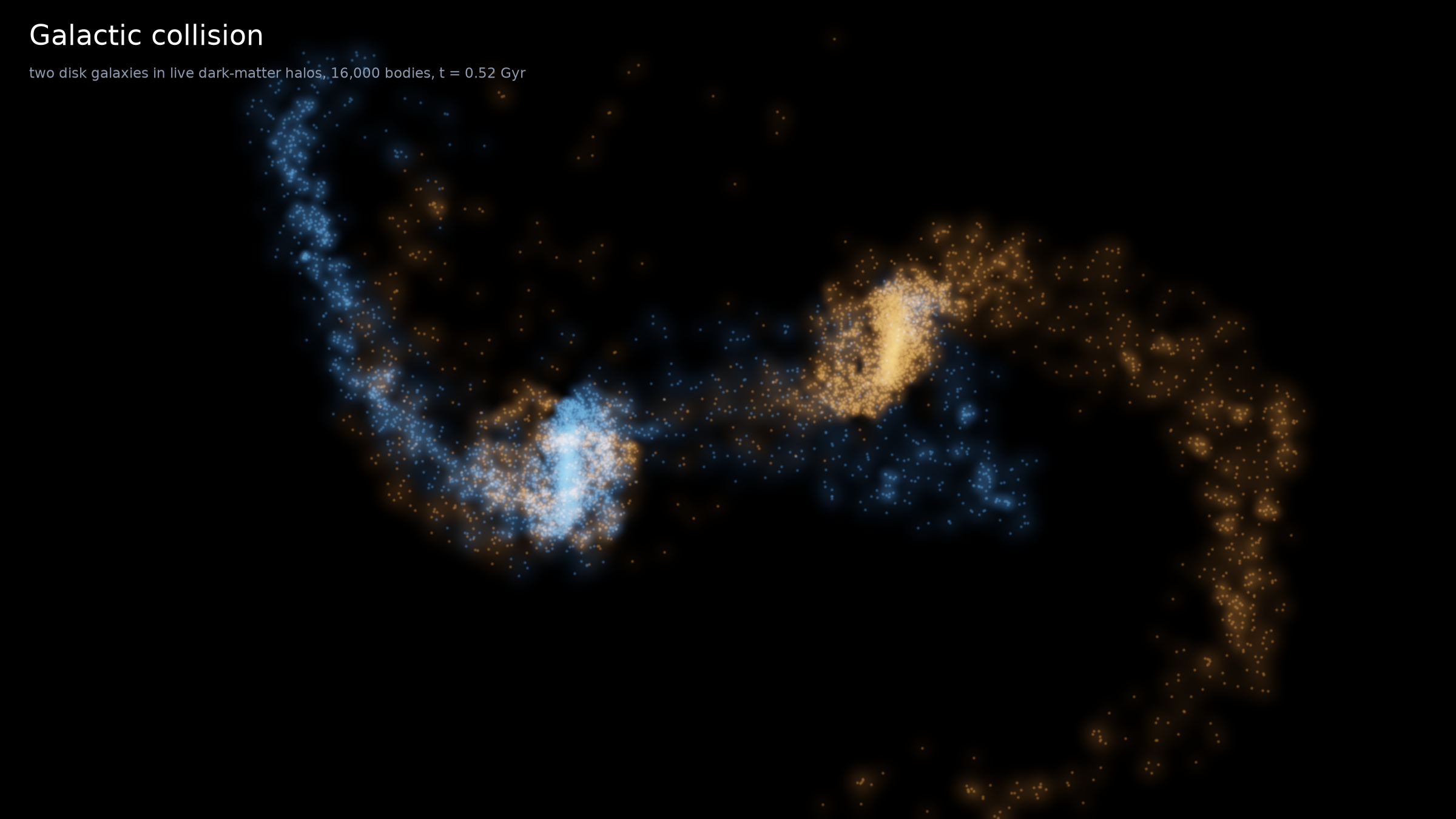 Level 5 · Astrophysics
Galactic Collision
N-body · symplectic integration · high-performance PythonTwo disk galaxies in live dark-matter halos swing past each other and throw out tidal tails, rendered to video with 16,000 bodies.
+ Numba JIT + prange+ ffmpeg videoVERIFIEDKepler period error 0.025%. Leapfrog energy stays bounded while Euler drifts to 80%. Code runs 1,558× faster than plain Python. -
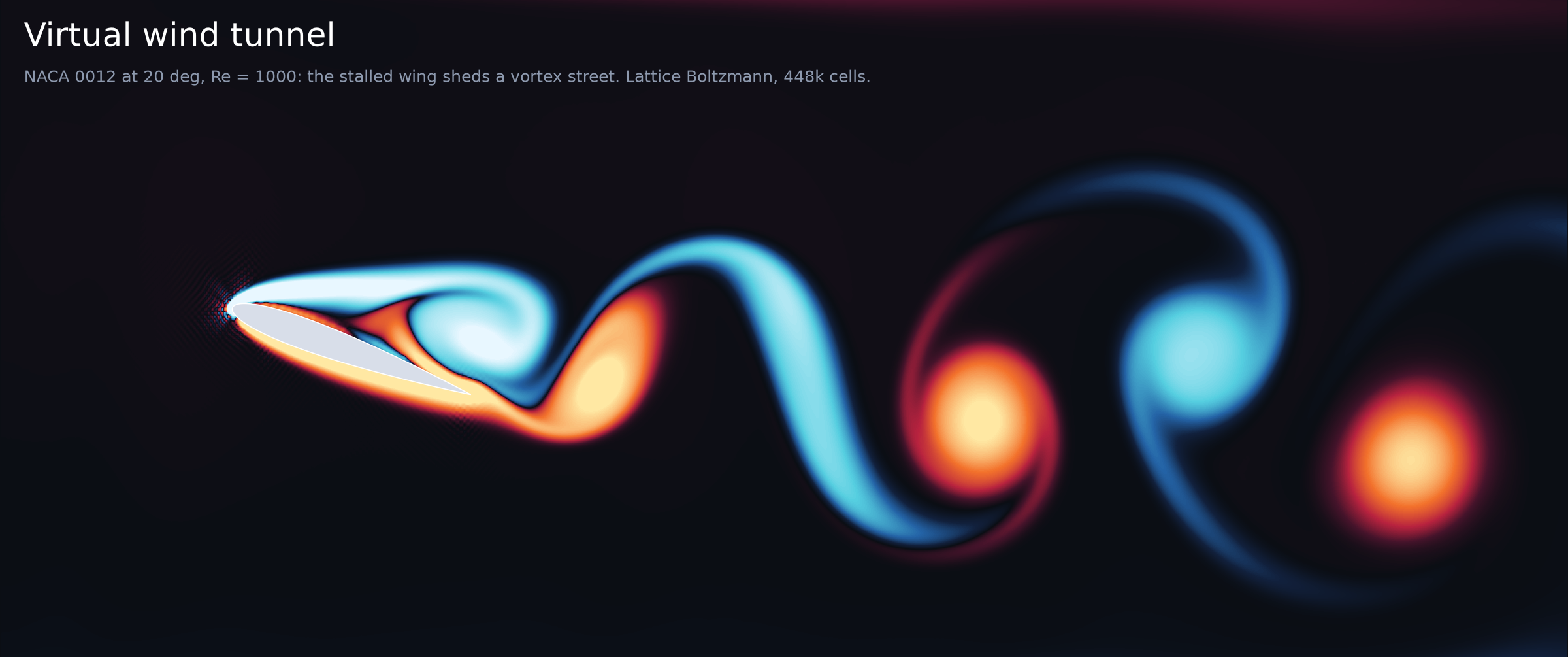 Level 6 · Fluid dynamics
Virtual Wind Tunnel
Lattice Boltzmann CFD · verification & validationA from-scratch lattice Boltzmann solver: Kármán vortex streets, a stalled airfoil and a lift/drag polar.
+ stencil kernels+ scipy.fft+ V&VVERIFIEDPoiseuille flow converges at exactly order 2.000. Schäfer–Turek Strouhal 0.3014 (range 0.295–0.305); cylinder Strouhal 0.1651 vs Williamson's 0.164. -
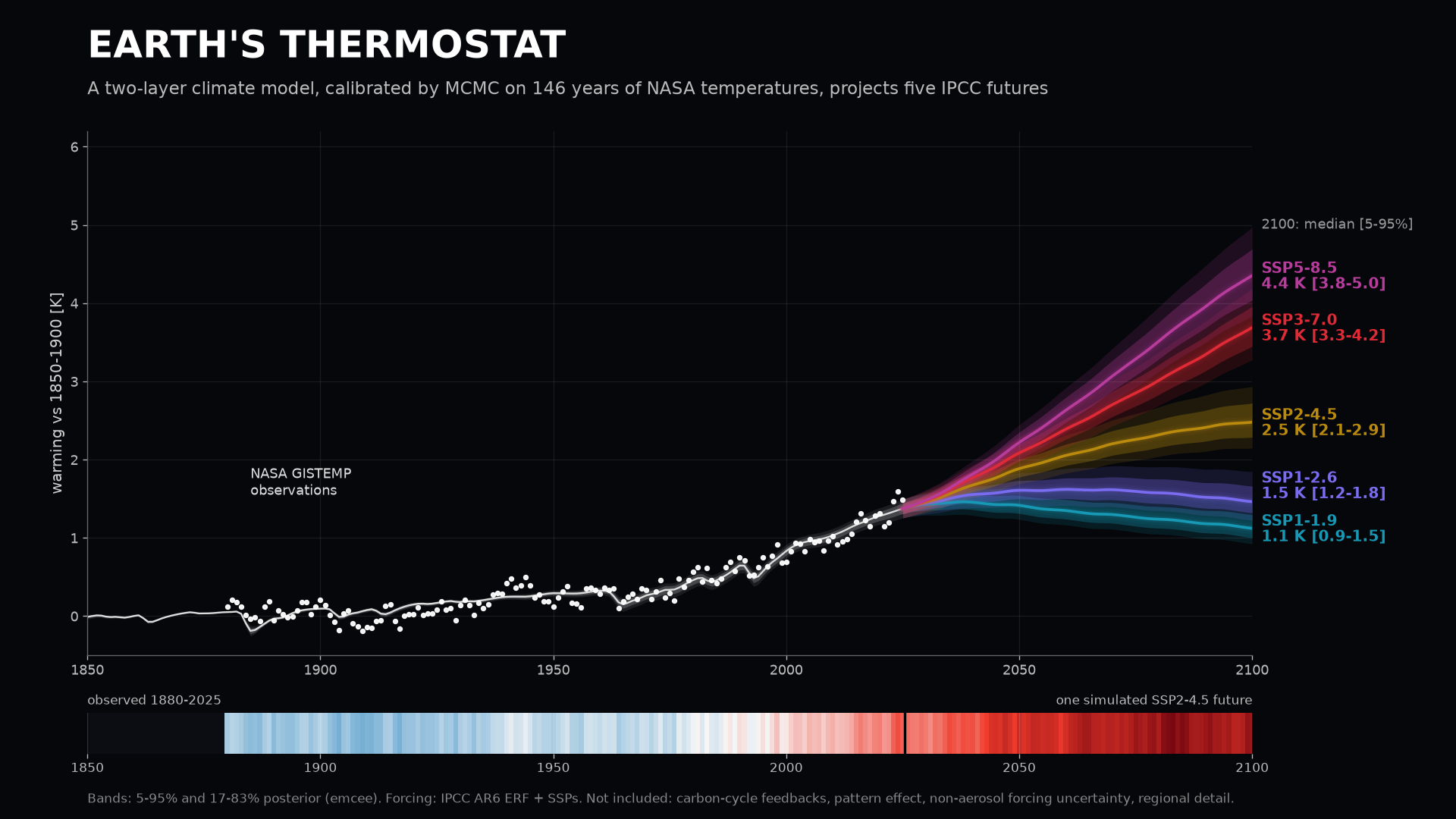 Level 7 · Climate science
Earth's Thermostat
Bayesian calibration · uncertainty · global sensitivityA two-layer energy-balance model calibrated by MCMC on 146 years of NASA temperatures, projecting five IPCC futures with honest error bands.
+ pandas+ live data APIs+ emcee MCMC+ SALib SobolVERIFIEDTransient climate response 1.60 [1.42, 1.80] K, inside the IPCC AR6 range. Recovers 10/10 synthetic truths; 93% of observations fall in the 90% band. -
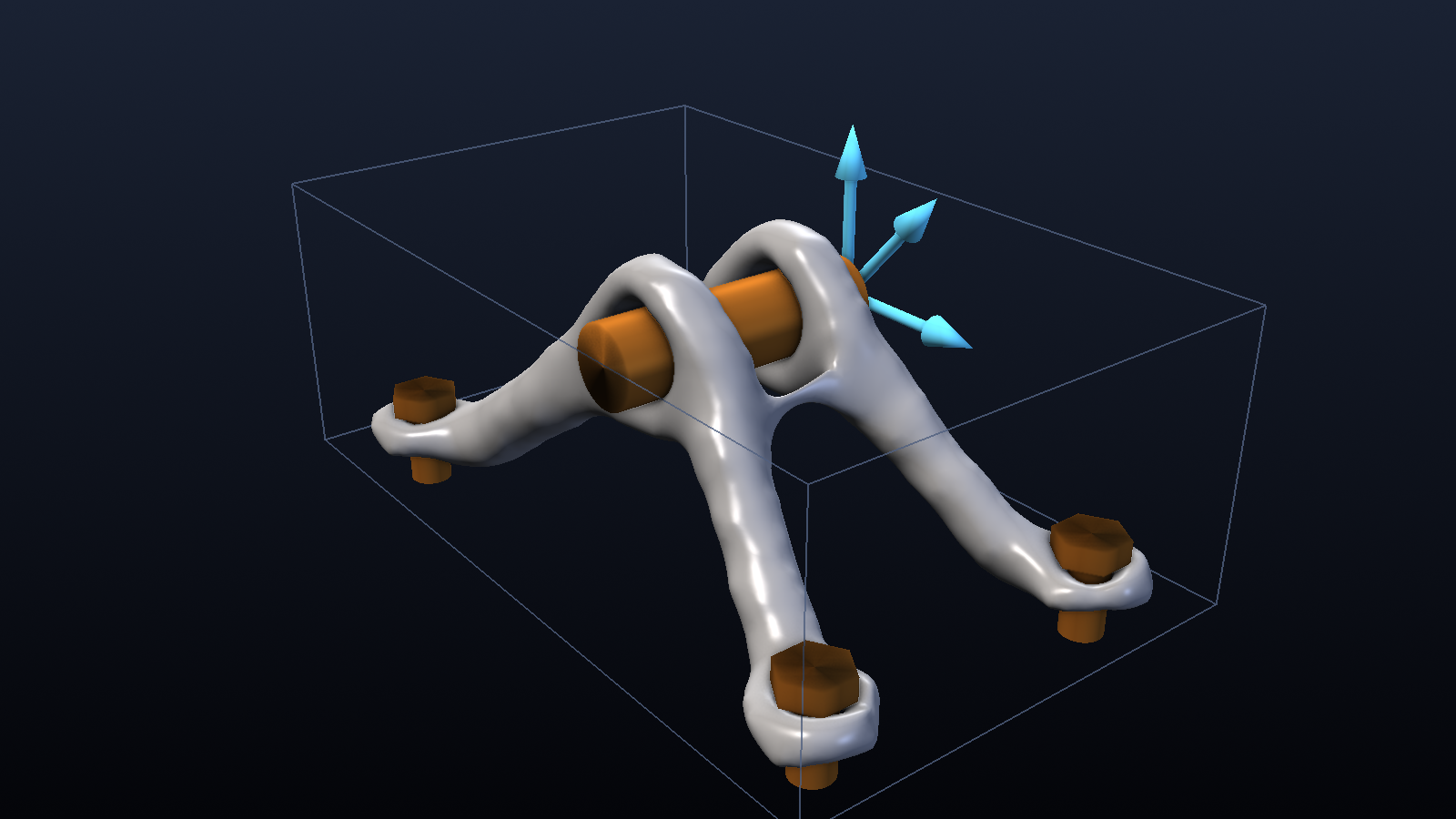 Level 8 · Structural engineering
Generative Bracket
Finite elements · 3D topology optimisationThe GE jet-engine bracket challenge: a computer grows the stiffest titanium bracket for four load cases, torsion included, and exports it as a printable STL.
+ scikit-fem+ pyamg+ PyVista / VTK+ STLVERIFIEDCantilever tip deflection within 1% of Euler–Bernoulli; exactly 8.00% volume; the STL is watertight (351 g of Ti-6Al-4V). -
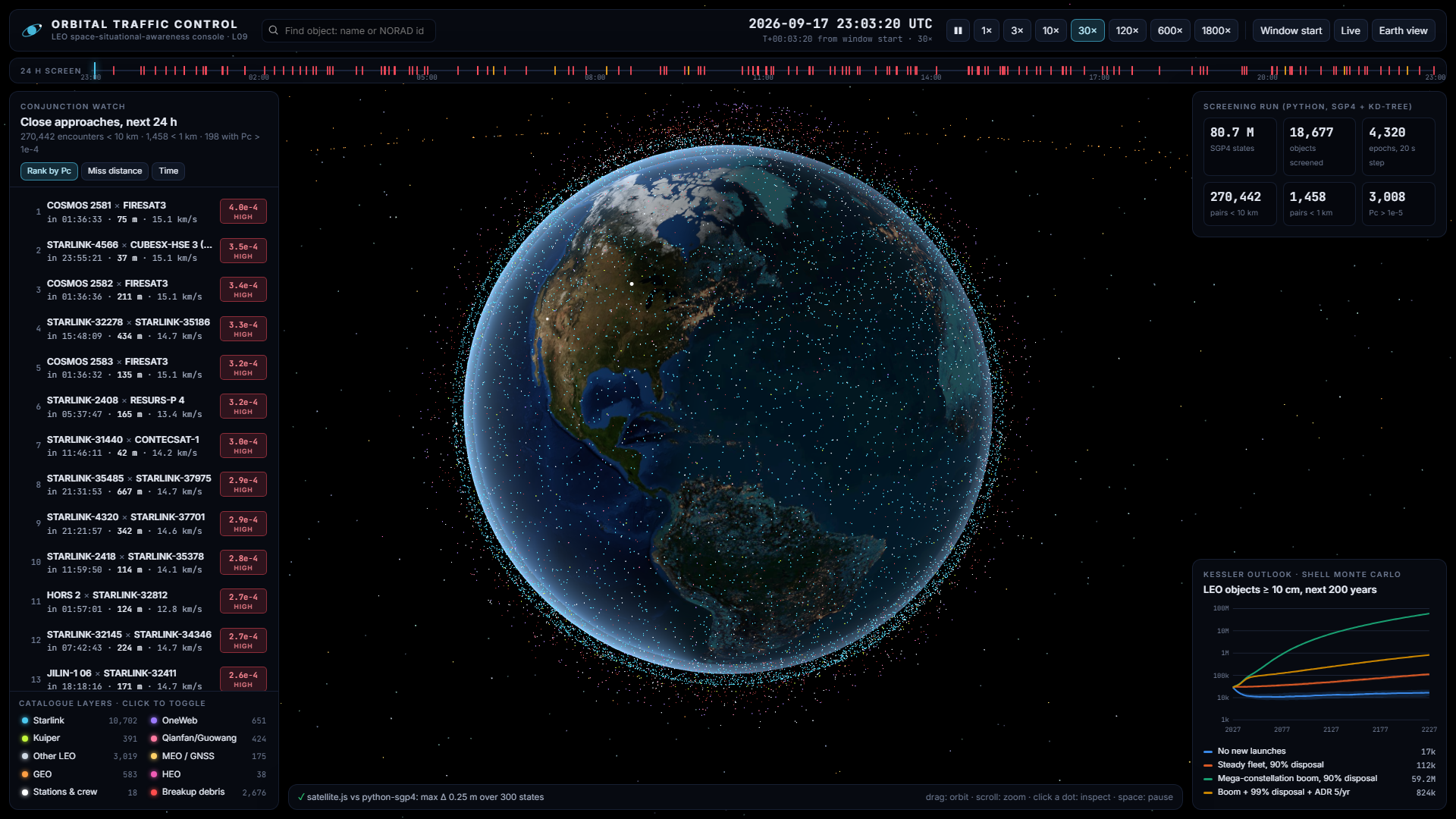 Level 9 · Astrodynamics · space safety
Orbital Traffic Control
Real catalogue · conjunction screening · debris Monte CarloAll 18,677 tracked objects on a live WebGL globe, the closest approaches over the next 24 hours, and a 200-year Kessler-syndrome outlook.
+ sgp4+ KD-trees+ Three.js+ satellite.jsVERIFIEDTwo independent orbit codes (python-sgp4, satellite.js) agree to 0.25 m. Top conjunction: a 75 m miss at 15.1 km/s. -
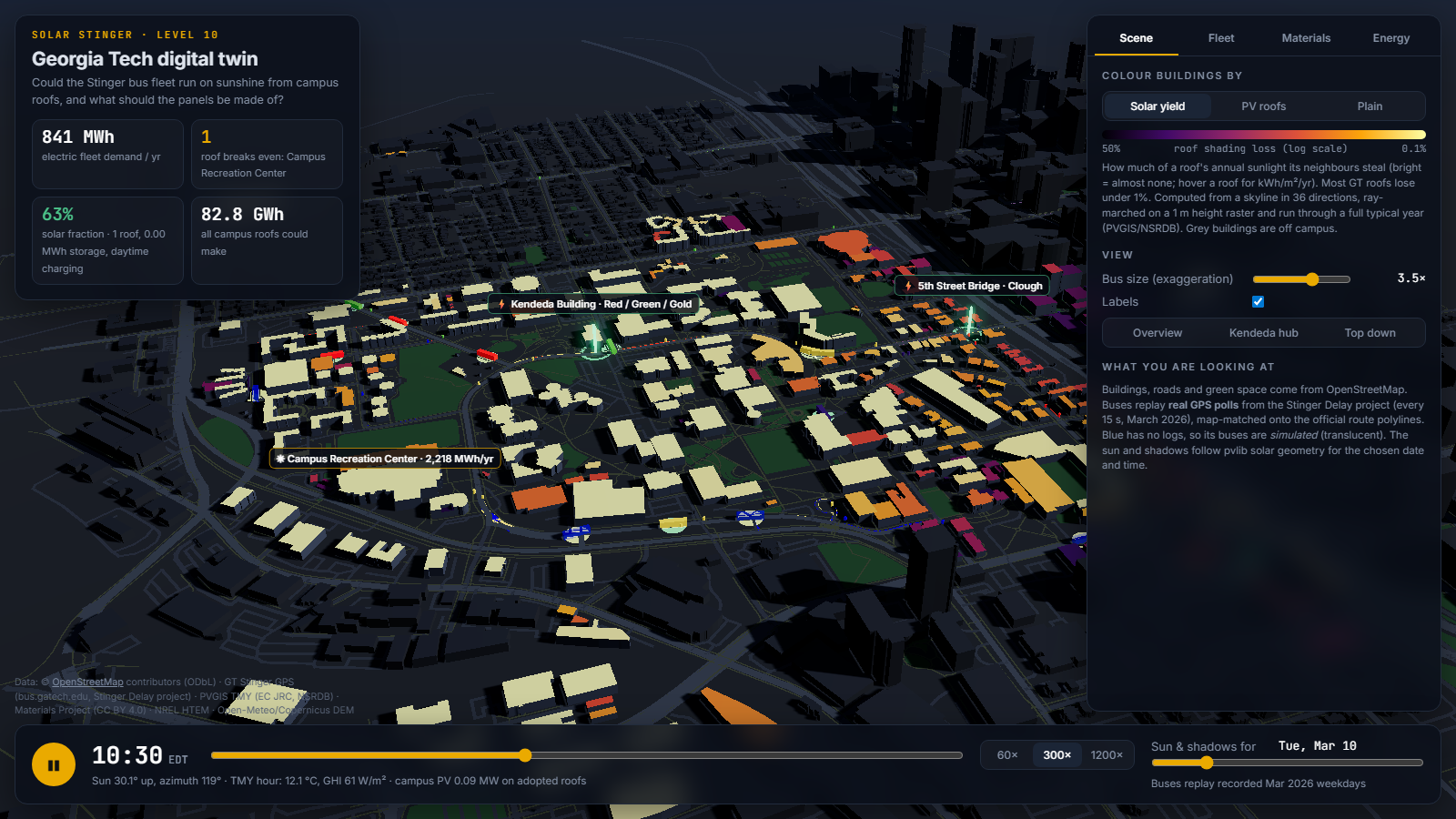 Level 10 · Energy · mobility · materials
Solar Stinger
Real-data multi-physics digital twinReal campus bus GPS, OpenStreetMap buildings, an NSRDB solar year and the Materials Project, coupled in one 3D twin. One roof could power the whole electric fleet, but only if the buses charge while the sun is up.
+ pvlib+ OpenStreetMap+ Materials Project+ NREL HTEM+ digital twinVERIFIEDHorizon ray-march 26.4° vs 26.3° analytic; SQ limit 33.69% at 1.34 eV vs 33.7%; solar yield 1,411 kWh/kWp vs PVWatts ~1,400.